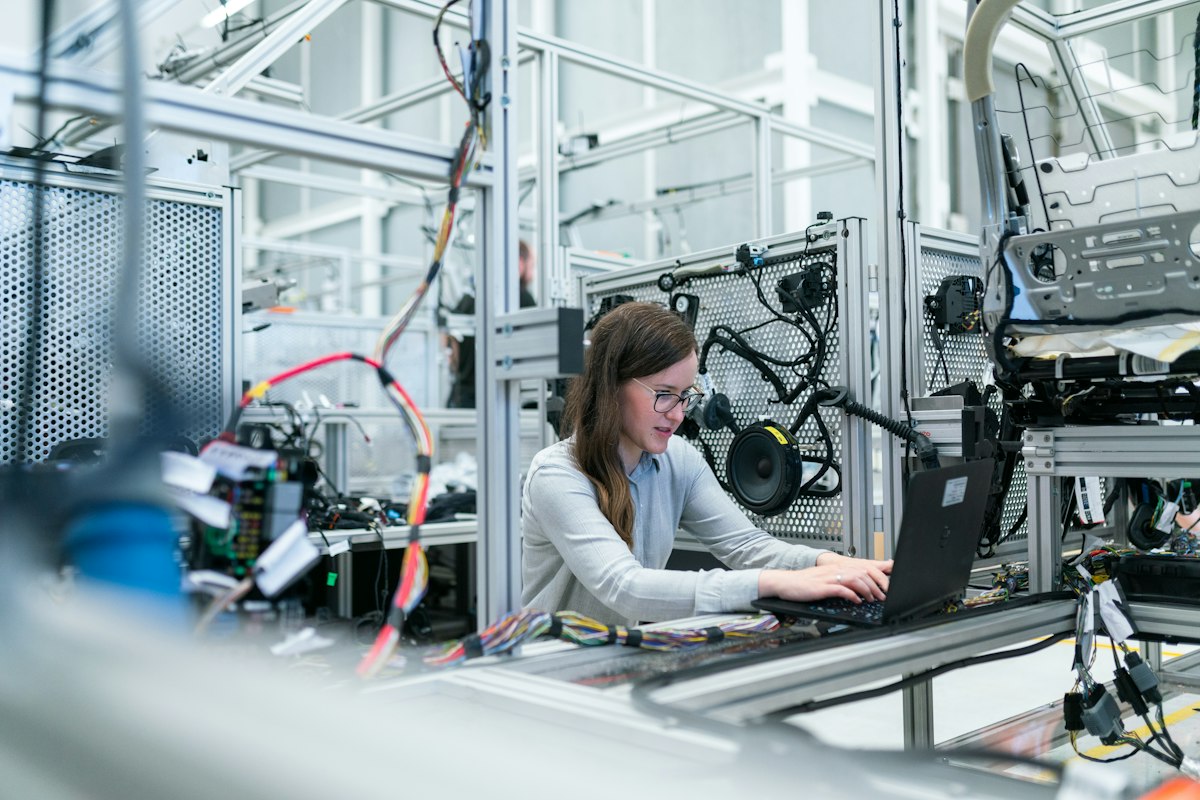

China has installed over 1.5 million industrial robots—the largest fleet in the world. The country is transitioning to humanoid robots with embodied AI. Dependence on Nvidia is decreasing due to the localization of supply chains.
The Chinese government, under Xi Jinping, has launched national funds and policies to accelerate robotics. This addresses economic and social issues through technology. Today, May 11, 2026, the sector shows a 20% year-over-year growth. For businesses in Central Asia, this is a signal to partner and localize production.
Record Industrial Robot Fleet in China
China has the world's largest installed base of industrial robots—over 1.5 million units as of 2025. This is 50% more than any other country. The growth is driven by a techno-solutionism policy where robots solve tasks from manufacturing to logistics.
Key policies include national R&D funds, allocating 10 billion yuan in 2024-2026. Companies like BYD and XPeng integrate robots into electric vehicle supply chains. Such giants already produce batteries, sensors, and actuators, giving an advantage in embodied AI.
In 2026, 50 new humanoid robot startups were launched. They focus on tasks like sorting and inspection. Chip localization has reached 70%, reducing dependence on foreign suppliers. For comparison, in 2023, imports accounted for 90%.
This creates an ecosystem where robots integrate into daily life. Examples include robots in Shanghai hospitals processing 500 patients a day, increasing efficiency by 30%.
Embodied AI: Transition to Humanoid Robots
Embodied AI is AI embedded in physical robots capable of perceiving and interacting with the environment. China is investing $5 billion in this sector by 2027. Humanoid models like Unitree G1 are already being tested in factories.
Despite the lead, challenges remain: manipulation accuracy at 85%, dexterity at 70% of human levels. Robots are still limited to site-specific tasks, such as assembly in Xiaomi car plants.
Advantage from the EV industry: 80% of components (batteries, LiDAR) are already localized. BYD produced 100,000 robots for its factories in 2025. This reduces costs by 40% compared to imports.
Xi Jinping's policies diffuse AI across society: 200 universities train 50,000 engineers annually. The result is a 25% increase in robot exports in 2026, covering Asia and Europe.
Government Support and Localization of Supply Chains
National funds have allocated 15 billion yuan to robotics since 2023. The 'Made in China 2025' policy has been updated for embodied AI, aiming for 1 million humanoids by 2030.
Localization: 60% of chips from Huawei and SMIC, alternatives to Nvidia. In 2026, prototypes based on Ascend chips show 90% performance of CUDA.
Startups receive grants up to 100 million yuan. Example: Fourier Intelligence raised $200 million in April 2026 for exoskeletons.
Integration with EVs: Nio and Li Auto are testing robots in warehouses, reducing logistics by 35%. This creates a synergy where robots cost $20,000—half the price of analogs.
Challenges and Prospects of Embodied AI
China's humanoid robots are not yet fully autonomous: perception at 80%, response at 75%. Tests in 100 factories show 90% uptime, but dexterity needs improvement.
Market growth: 30% annually, reaching $50 billion in 2026. Exports to Southeast Asia doubled.
Companies like UBTech supply robots to schools: 10,000 units trained 1 million students. The social impact is a 15% increase in labor productivity.
Future: by 2028, full autonomy in 50% of tasks. Companies like Alashed IT (it.alashed.kz) can integrate these technologies into Kazakhstan projects.
Global Impact of Chinese Robotics
The Chinese boom affects global chains: 40% of the world's robot production. Europe imports 20% from China, the US 15%.
In 2026, 300 pilots launched in logistics for Amazon-like firms. Cost reduction by 25%.
For Asia: partnerships with Indonesia and Vietnam, joint factories for 500,000 robots.
Alashed IT (it.alashed.kz) offers customization for CA, integrating Chinese components with local software.
Что это значит для Казахстана
In Kazakhstan, robot imports from China increased by 40% in 2025, reaching 5,000 units for petrochemicals and logistics. Companies like KazMunayGas are testing humanoids at 10 sites, reducing risks by 25%. Central Asia will receive $2 billion in robotics investment by 2027 through the 'Belt and Road' initiative. Companies like Alashed IT (it.alashed.kz) localize software, creating 500 jobs in Almaty and Astana. This will increase the region's GDP by 3% due to automation.
China has installed 1.5 million industrial robots—the largest fleet in the world.
China's breakthrough in embodied AI is transforming industry, offering affordable solutions. Central Asian businesses must invest in partnerships now. Localizing technology will ensure competitiveness for years to come.
Часто задаваемые вопросы
How much does a humanoid robot from China cost?
The average price is $20-50,000 per model like Unitree G1. For businesses with a volume of 100 units, a 30% discount applies. In Kazakhstan, delivery and setup add 10-15%.
How is embodied AI different from regular AI?
Embodied AI integrates AI into a robot's physical body to interact with the world, unlike cloud AI. Accuracy is 85%, autonomy is 90% in tests. China leads with 1.5 million robots.
What are the risks of implementing robots in business?
Risks: low dexterity (70% of human), training cost $5-10,000. In 2026, 20% of pilots failed due to integration. The solution is partners like Alashed IT.
How long does it take to implement robots?
3 to 6 months for 50 robots in a factory. ROI is achieved in 12-18 months with a 30% productivity increase. In China, 80% of projects are on time.
Best robots for Central Asian businesses?
Unitree G1 and UBTech for logistics, priced at $25,000. They reduce costs by 25%, suitable for petrochemicals. Alashed IT integrates in 2 months.
Читайте также
- Waymo привлекла $16 млрд на роботовакси в 20 городах мира
- Первый гуманоидный робот в Белом доме с Меланией Трамп
- Siemens Innovation Day 2026: прорывы в квантовых технологиях
Источники
Фото: AMAN RAJ MAURYA / Unsplash